
SODIUM HYDROXIDE
Structure

Caustic soda
Soda lye
Lye
Sodium hydrate
Formula: NaOH (HNaO)
Description: White, odorless, non-volatile, clear solution.
Uses: Vegetable oil refining, regenerating ion exchange resins, organic fusions, peeling of fruits and vegetables in food industry, etching and electroplating.
Registry Numbers and Inventories.
| CAS | 1310-73-2 |
| EC (EINECS/ELINCS) | 215-185-5 |
| EC Index Number | 011-002-00-6 |
| EC Class | Corrosive |
| EC Risk Phrase | R 35 |
| EC Safety Phrase | S 26-37/39-45 |
| ENCS (MITI) | 1-410 |
| RTECS | WB4900000 |
| RTECS class | Agricultural Chemical and Pesticide (A); Mutagen (M); Primary Irritant (S) |
| UN (DOT) | 1823 |
| Merck | 12,8772 |
| Listed on the Toxic Substancs Control Act (TSCA). | |
| Listed on Canadian Domestic Substances List (DSL). | |
| Listed on Australian Inventory of Chemical Substances (AICS). | |
Properties
| Formula mass | 40.00 |
| Melting point, °C | 323 |
| Boiling point, °C | 1390 |
| Vapor pressure, mmHg | 0.07 torr (300 °C) |
| Vapor density (air=1) | >AIR |
| Density | 1.3 g/cm3 |
| Solubility in water | 109 g/100 |
| Viscosity | 4.0 cp at 350°C. |
| Surface tension | 74.35 dynes/cm at 18°C |
| Acid/Base | Strong base |
| Heat of fusion | 50.0 cal/g |
| Heat of vaporization | 175 kj/mol @ 1388°C |
| Odor threshold | Odorless |
Hazards and Protection.
| Storage | Store in a tightly closed container. Store in a cool, dry, well-ventilated area away from incompatible substances. Corrosives area. Store protected from moisture. |
| WHMIS | E – Corrosive material |
| Handling | Wash thoroughly after handling. Do not allow water to get into the container because of violent reaction. Minimize dust generation and accumulation. Avoid contact with eyes, skin, and clothing. Keep container tightly closed. Avoid ingestion and inhalation. Use with adequate ventilation. Discard contaminated shoes. |
| Protection | Eyes: Wear appropriate protective eyeglasses or chemical safety goggles as described by OSHA’s eye and face protection regulations in 29 CFR 1910.133 or European Standard EN166. Skin: Wear appropriate protective gloves to prevent skin exposure. Clothing: Wear appropriate protective clothing to minimize contact with skin. |
| Respirators | A respiratory protection program that meets OSHA’s 29 CFR 1910.134 and ANSI Z88.2 requirements or European Standard EN 149 must be followed whenever workplace conditions warrant a respirator’s use. |
| Small spills/leaks | Vacuum or sweep up material and place into a suitable disposal container. Avoid runoff into storm sewers and ditches which lead to waterways. Clean up spills immediately, using the appropriate protective equipment. Avoid generating dusty conditions. Provide ventilation. |
| Stability | Stable at room temperature in closed containers under normal storage and handling conditions. |
| Incompatibilities | Moisture, acids, acid chlorides, strong acids, strong bases, strong oxidizing agents, strong reducing agents. |
| Decomposition | Irritating and toxic fumes and gases, toxic fumes of sodium oxide, sodium peroxide fumes. |
| Other hazards | Slowly corrosive to iron and copper. Attacks wool, leather, tin, aluminum, zinc and related alloys. |

Fire.
| Flash Point,°C | None | |||
| Fire fighting | Wear a self-contained breathing apparatus in pressure-demand, MSHA/NIOSH (approved or equivalent), and full protective gear. During a fire, irritating and highly toxic gases may be generated by thermal decomposition or combustion. Wear appropriate protective clothing to prevent contact with skin and eyes. Wear a self-contained breathing apparatus (SCBA) to prevent contact with thermal decomposition products. Use water with caution and in flooding amounts. Contact with moisture or water may generate sufficient heat to ignite nearby combustible materials. Extinguishing media: Use agent most appropriate to extinguish fire. In case of fire use water spray, dry chemical, carbon dioxide, or appropriate foam. | |||
| Fire potential | Nonflammable. | |||
| Hazards | Some are oxidizers and may ignite combustibles (wood, paper, oil, clothing, etc.). Contact with metals may evolve flammable hydrogen gas. Containers may explode when heated. | |||
| Combustion products | Non-combustible, substance itself does not burn but may decompose upon heating to produce corrosive and/or toxic fumes. | |||
| NFPA | Health:3 Flammability:0 Reactivity:1 Special: – | |||
Health
| Exposure limit(s) | OSHA PEL: TWA 2 mg/m3 NIOSH REL: C 2 mg/m3 NIOSH IDLH: 10 mg/m3 |
| Exposure effects | Prolonged or repeated skin contact may cause dermatitis. Effects may be delayed. |
| Ingestion | May cause severe and permanent damage to the digestive tract. Causes gastrointestinal tract burns. May cause perforation of the digestive tract. Causes severe pain, nausea, vomiting, diarrhea, and shock. May cause corrosion and permanent tissue destruction of the esophagus and digestive tract. May cause systemic effects. |
| Inhalation | Irritation may lead to chemical pneumonitis and pulmonary edema. Causes severe irritation of upper respiratory tract with coughing, burns, breathing difficulty, and possible coma. Causes chemical burns to the respiratory tract. Aspiration may lead to pulmonary edema. May cause systemic effects. |
| Skin | Causes skin burns. May cause deep, penetrating ulcers of the skin. May cause skin rash (in milder cases), and cold and clammy skin with cyanosis or pale color. |
| First aid | |
| Ingestion | Do NOT induce vomiting. If victim is conscious and alert, give 2-4 cupfuls of milk or water. Get medical aid immediately. |
| Inhalation | Get medical aid immediately. Remove from exposure to fresh air immediately. If not breathing, give artificial respiration. If breathing is difficult, give oxygen. DO NOT use mouth-to-mouth respiration. If breathing has ceased apply artificial respiration using oxygen and a suitable mechanical device such as a bag and a mask. |
| Skin | Get medical aid. Flush skin with plenty of soap and water for at least 15 minutes while removing contaminated clothing and shoes. Wash clothing before reuse. Discard contaminated clothing in a manner which limits further exposure. |
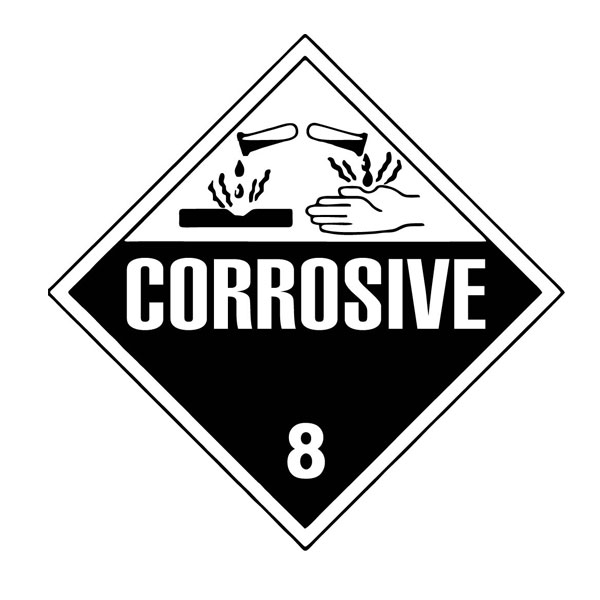
Transport
| UN number | 1823 |
| Response guide |  154 |
| Hazard class | 8 |
| Packing Group | II |
| USCG CHRIS Code | CSS |
| USCG Compatatibility Group | 5 Caustics |